Poverty
2× the poverty rate
U.S. population · 2022 ACS. Lower is better.
GIVE THE GIFT OF TACTILE LEARNING
The chance to learn. The freedom to create.
Your gift helps make both more accessible.
Literacy and accessibility are rights, not privileges.
THE TOUCHPAD PRO FOUNDATIONTHE COST OF UNEQUAL ACCESS
A learner raises a braille dot, feels a new letter, erases it, and tries again. Without an affordable way to practice, that chance can end when the lesson does. Your gift can help put tactile learning within reach.
A study published in 2025
Employed participants who were blind had nearly four times the odds of reporting strong Braille skills compared with unemployed participants.
Help put Braille learning within reach. Your gift supports access to BrailleDoodle for learners who cannot afford a device.
264 participants who were blind. Unemployed = 1× baseline. These are adjusted odds, not employment percentages. The study shows a connection, not cause and effect.
2× the poverty rate
U.S. population · 2022 ACS. Lower is better.
31-point employment gap
U.S. adults ages 16–65 · 2023 CPS. Higher is better.
19.7% of U.S. adults ages 25–64 with vision disabilities held a bachelor’s degree or higher in 2023. This measures degree attainment, not completion among students who enrolled.
Braille proficiency and employment: McDonnall et al. (2025), Factors Associated with Proficient Braille Skills in Adults, Table 2. The graph uses the study’s blindness subgroup (264 participants). Employed participants had 3.93 times the adjusted odds of self-reported Braille proficiency compared with unemployed participants (95% confidence interval: 1.55–9.95). Surveys were collected in 2021–2022. This was a selected sample of adults who were working or seeking employment, not a national literacy estimate.
Poverty and employment: American Foundation for the Blind, The Disability Squeeze. The comparison groups differ: poverty compares people with vision difficulty to people without any disability; employment compares people with and without blindness or low vision.
Education: 2025 Disability Statistics Compendium, Table A.9, using 2023 ACS data for civilians living in the community. Vision disability includes blindness or serious difficulty seeing even with glasses. Poverty and employment percentage bars use a full 0–100% scale; the Braille proficiency graph uses a 0–4× odds scale. These figures describe population disparities; they do not establish their causes or measure BrailleDoodle’s effects.
HELP OPEN A DOOR
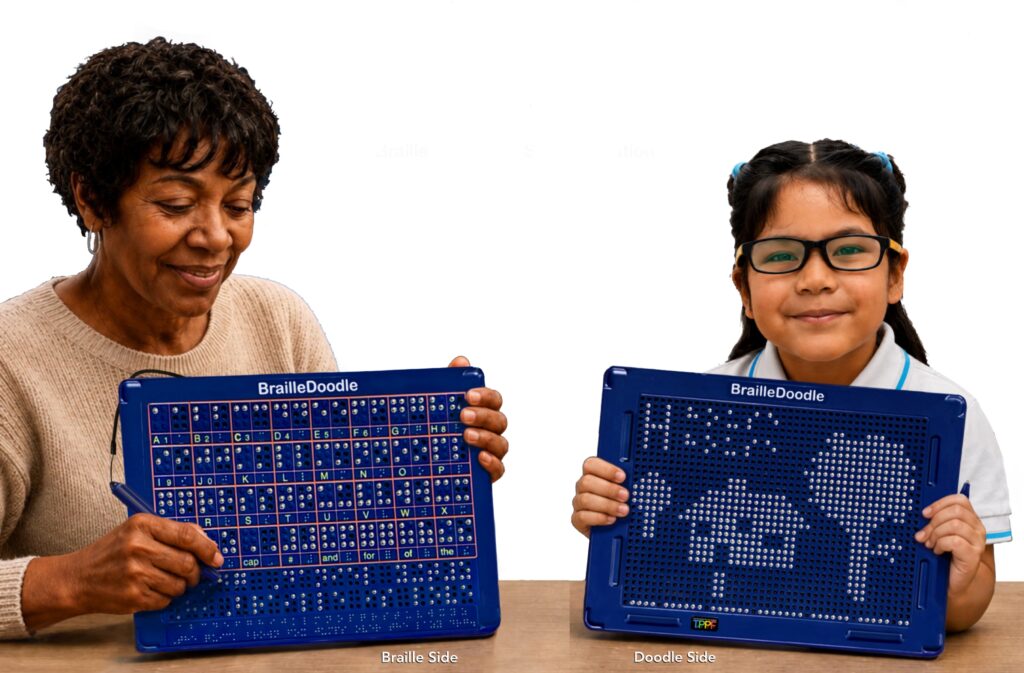
BrailleDoodle makes braille practice, tactile science and math, and creative expression hands-on. No batteries. No screens. No internet. Your gift supports our work to reach more learners, including those who cannot afford a device.
THE POSSIBILITY BEHIND YOUR GIFT
A letter felt for the first time. An idea made into a tactile drawing. A lesson explored together. These are the possibilities behind BrailleDoodle.
A reusable surface where learners can form braille characters, feel the dots, and practice again.
Drawings, shapes, graphs, and ideas become something to explore through touch.
A hands-on tool for learners, families, and educators—without batteries, screens, or internet.
BUILT FROM A TEACHER’S IDEA
After years teaching students who are blind or have low vision, educator and inventor Daniel Lubiner created BrailleDoodle with their needs and ideas in mind.
Your donation supports the Foundation’s work to make tactile learning accessible, including for people who cannot afford a device.
Meet the people behind the FoundationGIVE WITH CONFIDENCE
Have a question before you give?
We’re here to help.
Your gift supports the TouchPad Pro Foundation’s mission to expand access to braille literacy and tactile learning through BrailleDoodle, including for people who may not be able to afford a device.
If you want to support a particular school, organization, or group of learners, please contact us to discuss your gift.
Yes. Please make your check payable to The TouchPadPro Foundation and mail it to:
63 Livingston AvenueWe welcome conversations with individuals, businesses, schools, and organizations interested in supporting access to BrailleDoodle.
Email info@brailledoodle.org to discuss a larger gift or a specific group you would like to support.
The TouchPad Pro Foundation is a 501(c)(3) nonprofit. Contact us for our IRS determination letter and tax identification information.
Your generosity can help make tactile learning more accessible.