
Accessible STEM Activities: Teach Shapes, Graphs, and Maps by Touch brings a practical, hands-on approach to accessible learning. The ideas below can be adapted for educators, families, and learners of different ages.
STEM is more than what students can see
Math and science frequently rely on diagrams, charts, geometric figures, and graphs. Tactile instruction can give blind and low-vision learners access to spatial information through touch, supported by clear language and hands-on experimentation. Materials should be adapted to the student and learning objective.
Activity one: explore geometry
Ask students to create triangles, rectangles, and squares. Compare the number of sides and corners by touch. Progress to discussing size and symmetry. Use clear, uncrowded figures and allow a learner to inspect the full shape before answering questions.
Activity two: create a simple coordinate graph
Begin with a tactile horizontal and vertical axis. Agree on a scale and identify the origin. Plot a small number of points and trace how their positions change. Use physical labels or supplemental accessible notation as appropriate; a tactile drawing board is not a substitute for precise embossed graphs when exact measurements matter.
Activity three: map the classroom
Represent a door, desk, table, and path with a simplified tactile map. Practice directional vocabulary and relate the map to real movement, using orientation-and-mobility instruction where needed. Students can build and revise maps as the room changes.
A reusable surface for exploration
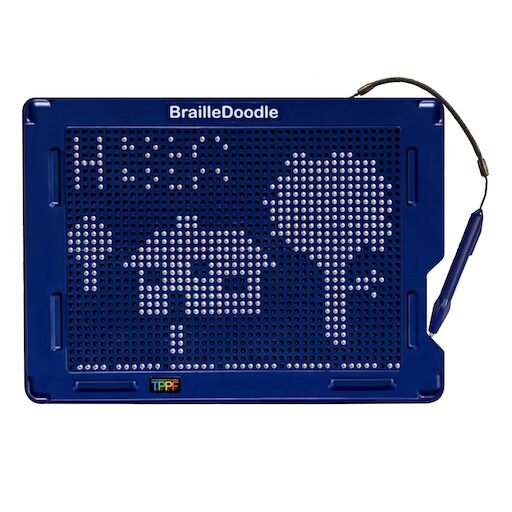
BrailleDoodle’s Doodle Side is a 41 × 31 grid of raised-ball positions; students can draw, feel, erase, and revise their work without a screen. The separate Braille Side supports literacy practice. Learn about the product at BrailleDoodle.org. See additional accessible-learning resources from APH.
Related topics: Braille literacy, tactile learning, accessible education, and inclusive art.