
What does one-half actually feel like? For a student who is blind or has low vision, the answer should begin with a whole object and equal parts—not with a picture that depends on color. This tactile fractions lesson moves from physical fraction pieces to simple raised-dot fraction bars. Teachers and families can adapt it for learners who are ready to compare halves, thirds, and quarters.
The instructional principle is straightforward: the whole must stay the same size when comparing fractions. A half of one object cannot be compared fairly with a quarter of a different-sized object. American Printing House for the Blind (APH) MathBuilders: Fractions uses physical fraction circles and bars to develop these ideas. Paths to Literacy also recommends beginning with materials learners can handle, fold, and divide.
Learning goals for a tactile fractions lesson
After guided practice, the learner should have opportunities to identify a whole, distinguish equal from unequal parts, locate one-half, one-third, and one-quarter, and explain why two quarters have the same length as one half when both refer to the same whole. The activities are a teaching suggestion, not a clinically validated intervention or a guarantee of learning within a set number of minutes.
Materials to prepare
- Two or three identical cardboard strips or accessible fraction bars of the same total length.
- Pre-cut matching pieces for halves, thirds, and quarters, preferably with distinct tactile edges or textures.
- Braille or large-print labels as appropriate for the learner, plus a clear tray or mat to keep pieces from shifting.
- A reusable tactile drawing surface such as the BrailleDoodle Doodle Side, or another method for making raised-line diagrams.
- Optional: a tactile ruler or a teacher-made grid guide for checking equal intervals.
Use pieces large enough to explore comfortably, and avoid small loose items for students who might put them in their mouths. A teacher of students with visual impairments (TVI) can help choose appropriate symbol size, spacing, and labeling.
Step-by-step: teach halves, thirds, and quarters by touch
Step 1: Establish the whole with real objects
Give the learner one intact cardboard strip. Invite them to trace its full length from left to right and find both ends. Call it one whole. Place an identical strip next to it and confirm that the endpoints align. This fixed reference matters: the denominator describes equal parts of the same whole.
Step 2: Make equal halves and test the idea
Offer two pieces that together exactly match the whole strip. Ask the learner to place them end to end. Each is one-half (1/2), and two halves make one whole. Next, show an intentionally uneven pair. Ask whether the two pieces are both halves. The correct answer is no: two parts are not necessarily two equal parts.
For learners who benefit from daily-life examples, fold a rectangular sheet into two equal sections or use a set of safe, appropriately sized fraction manipulatives. Perkins School for the Blind offers a related hands-on lesson using cardboard circles to explore fraction operations.
Step 3: Compare thirds and quarters using the same whole
Now present three equal pieces that reconstruct the whole strip. Name each one-third (1/3). Repeat with four equal pieces, each one-quarter (1/4). Ask: “When the whole stays the same, is one-third longer or shorter than one-quarter?” Have the learner align the left edges of the pieces to discover that 1/3 is larger than 1/4.
This comparison can feel counterintuitive because four is a larger number than three. Explain that dividing the same whole into more equal pieces makes each piece smaller. Let the student demonstrate the explanation with the objects rather than relying on verbal repetition.
Step 4: Draw tactile fraction bars
Only after the learner understands the physical pieces, introduce a simplified raised-dot bar model. On a tactile drawing surface, make one horizontal bar representing the whole. Directly below it, make an equally long bar with a clear midpoint divider for halves. Add another bar divided into thirds, then one divided into quarters. Keep all four bars exactly the same overall length and aligned at the left edge.
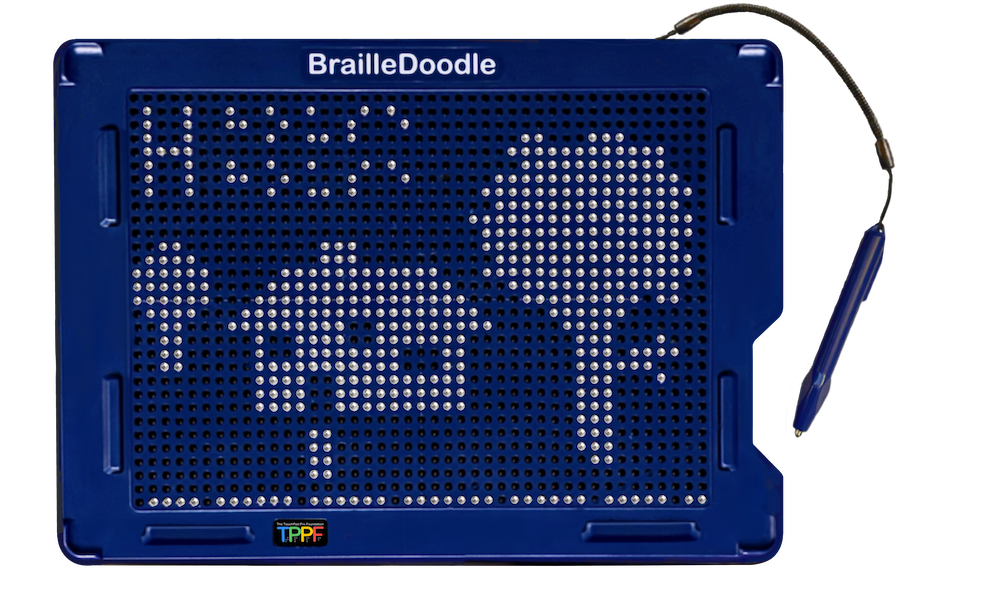
On BrailleDoodle’s Doodle Side, the grid is arranged 41 × 31. For a practical teacher-prepared example, choose a horizontal span of 24 equal grid intervals between two endpoints, leaving enough space around the bars. Place dividers at the 12-interval mark for halves, at 8 and 16 intervals for thirds, and at 6, 12, and 18 intervals for quarters. Each interval is the space between adjacent grid positions; 24 intervals require 25 endpoint positions. The numbers here describe a possible teaching layout, not a product specification or an additional total-hole count.
Use separate rows with generous vertical spacing. If a student cannot distinguish the bar outlines from the internal dividers, reduce the number of bars shown at once, enlarge the representation using another tactile medium, or return to physical fraction pieces. The grid is a reusable learning surface, not a calibrated measuring instrument or a substitute for professionally prepared tactile graphics.
Step 5: Discover that two quarters equal one half
Place two quarter pieces end to end against a half piece. They should align. Then have the learner trace the quarter bar from its left endpoint through the first divider to the midpoint: 2/4 covers the same portion of the whole as 1/2. Ask the learner to explain this with the objects and then with the tactile bars. If the drawing is confusing, the physical pieces remain the primary evidence.
How to make the lesson genuinely accessible
Use labels and a predictable exploration order
Introduce the whole first. Let the learner find the left endpoint, trace to the right endpoint, return to the start, and then locate dividers. Keep labels in a consistent position, or supply separate Braille/large-print cards identifying “whole,” “halves,” “thirds,” and “quarters.” Provide an accessible description of each bar’s purpose, not just its appearance.
Do not rely on color or crowded textures
Color can help some low-vision learners, but it must not be the only way to distinguish parts. Avoid filling every section with dense raised dots, which can obscure the dividers. The Braille Authority of North America’s Guidelines and Standards for Tactile Graphics, 2022 offers broader principles for clear, readable tactile graphics. These homemade bars are introductory manipulatives rather than textbook-quality tactile diagrams.
Coordinate mathematical notation with the student’s instruction
Use spoken fraction names and accessible labels at the learner’s level. When introducing written fraction notation, coordinate with the TVI and the math teacher about the student’s applicable Braille mathematics code. Project INSPIRE’s fraction and mixed-number lesson is a resource for educators teaching Nemeth notation. Do not assume that a raised-dot bar automatically teaches how to read a fraction in Braille.
Using BrailleDoodle for repeatable fraction practice
The BrailleDoodle has a separate Braille Side for literacy practice and a Doodle Side with a 41 × 31 grid for tactile drawing. Its magnetic stylus raises dots, which can be pressed down to revise a drawing. The listed retail price is $179 USD. Teachers can erase and redraw the same-length bars to test new divisions without creating a permanent diagram each time.
For other accessible mathematics ideas, see our tactile bar graph lesson and tactile symmetry lesson. Our Directions and Lessons page provides device guidance. For a dedicated set of fraction manipulatives and curriculum materials, see APH MathBuilders: Fractions.
Quick assessment: four questions to ask
- Can the learner identify which object represents the whole?
- Can they explain why two unequal pieces are not two halves?
- Can they show which is larger, one-third or one-quarter, using the same-sized whole?
- Can they demonstrate that two quarters equal one half with pieces or a readable tactile bar?
Record whether each response was independent, prompted, or not yet demonstrated. If the student has difficulty, simplify to whole and halves before returning to thirds and quarters. The aim is conceptual understanding, not speed.
Further reading and verified sources
- American Printing House for the Blind — MathBuilders: Fractions: fraction circles, bars, and supplementary curriculum.
- Paths to Literacy — Teaching Fractions with Appropriate Materials: concrete teaching approaches and accessible manipulatives.
- Perkins School for the Blind — Adding Fractions Using a Cardboard Circle: tactile fraction-piece activity.
- Braille Authority of North America — Guidelines and Standards for Tactile Graphics, 2022: design guidance for readable tactile graphics.
- Paths to Literacy / Project INSPIRE — Fractions and Mixed Numbers: math Braille instruction resource.