
How does a beginning Braille reader know that a letter is capitalized? In Unified English Braille (UEB), a single capital letter is introduced by a capital indicator using dot 6. This hands-on Braille capital letters lesson gives teachers and families a manageable way to teach that convention without confusing the indicator with a letter of the alphabet.
What does dot 6 mean in Braille capitalization?
A standard six-dot Braille cell has dots 1, 2, 3 down its left column and dots 4, 5, 6 down its right column. Dot 6 is the bottom-right position. In UEB, the capital indicator ⠠ (dot 6) immediately before a letter tells the reader that the following letter is uppercase. The indicator is a separate cell, not an extra dot added to the letter.
For example, lowercase a is ⠁ (dot 1), while uppercase A is ⠠⠁ (capital indicator followed by a). Lowercase b is ⠃ (dots 1-2); uppercase B is ⠠⠃. Lowercase c is ⠉ (dots 1-4); uppercase C is ⠠⠉. These are uncontracted letter examples; they do not attempt to cover every capitalization rule used in longer words or passages.
Teachers should consult the official International Council on English Braille UEB resources for complete capitalization rules, including capitalized words and passages. This introductory lesson deliberately teaches one capital letter at a time.
Materials and learning goals
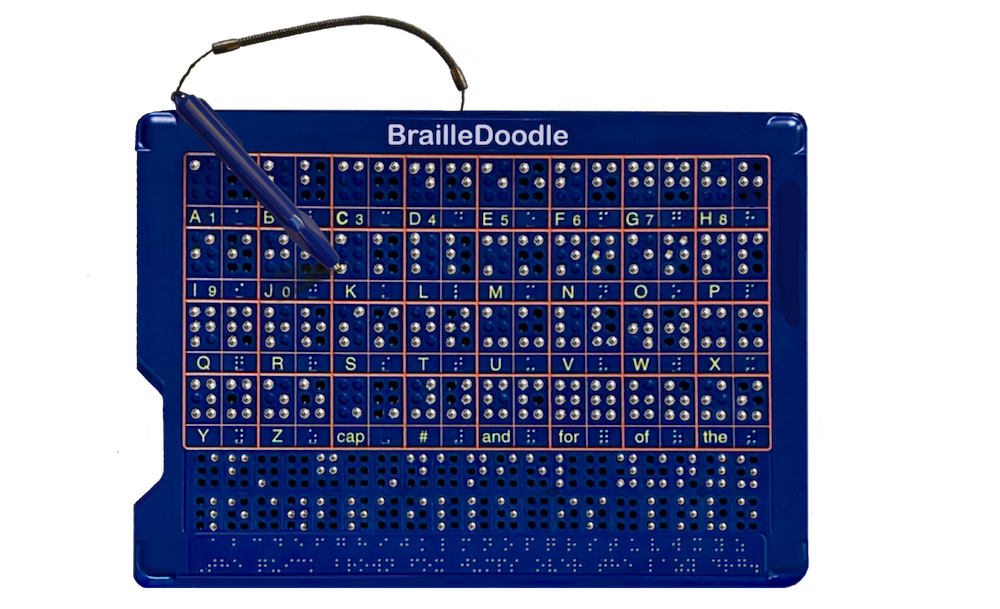
Allow about 20–25 minutes. Use a BrailleDoodle Braille Side or another reusable Braille practice surface, a few large tactile model cells, a short set of printed/Brailled letter cards, and an accessible way to record responses. Students should already have explored the six dot positions and recognized at least one or two lowercase letters. If not, start with our Braille dot numbers 1–6 lesson.
By the end, a learner should have opportunities to locate dot 6, recognize the capital indicator as its own cell, distinguish a lowercase letter from its uppercase form, and produce two or three capitalized letters with progressively less prompting. This is a practice activity, not a standardized assessment.
Five steps to teach the Braille capital indicator
1. Revisit the six-dot cell (3 minutes)
Let the student feel a full six-dot model. Identify the left column (1–2–3) and right column (4–5–6). Ask the learner to locate dot 6 independently. If orientation is difficult, keep the cell’s top edge consistently marked and revisit tactile cell exploration before moving on.
2. Make a single dot 6 (4 minutes)
Use a blank practice cell and raise only the bottom-right dot. Name it the capital indicator. Have the student compare that one-dot pattern with the letter a, which uses only the top-left dot (dot 1). Ask: “Which cell is a letter, and which is a signal about the next letter?”
3. Build lowercase a and uppercase A (5 minutes)
Make two adjacent cells: dot 6 in the first, dot 1 in the second. Read them together as uppercase A. Then present a single dot-1 cell as lowercase a. Invite the learner to trace the cells left to right, naming the indicator before the letter. Avoid stacking the two patterns into one cell.
4. Repeat with b and c (5 minutes)
Present lowercase b (dots 1-2) and c (dots 1-4), then add a preceding dot-6 cell to form uppercase B and C. Alternate examples so the learner cannot simply memorize a repeating “capital, lowercase” order. Keep cell spacing and orientation consistent.
5. Play a capitalization detective game (5–8 minutes)
Offer four short patterns such as a, A, b, and B in Braille. Ask the learner to sort them into lowercase and uppercase groups, explain which extra cell changed the meaning, and correct one deliberately missing capital indicator. A learner ready for a challenge can make the initial letter of their own name uppercase. Verify the spelling and symbols against a trusted Braille reference first.
Common mistakes and accessible teaching adjustments
Do not treat dot 6 as part of the letter cell
The most important distinction is that capitalization uses a separate preceding cell. If a student raises dot 6 in the same cell as a, show the two-cell arrangement again and compare it with the single-cell lowercase letter. Explain that adding dots within a letter cell can create a different Braille character.
Keep tactile examples simple and consistent
Begin with two-cell examples before introducing whole words. Offer a stable left-to-right reading direction, enough space to distinguish neighboring cells, and time to explore each cell without rushing. Some students benefit from a larger tactile model before transitioning to standard-size Braille. Coordinate the pace and instructional approach with the student’s teacher of students with visual impairments (TVI).
Use visual supports only when helpful
For learners who use residual vision, pair the tactile pattern with high-contrast print a/A or b/B. Do not require visual recognition to complete the activity. Read the letter names aloud when introducing them, then allow independent tactile identification during practice.
How BrailleDoodle can support this activity
The BrailleDoodle is a two-sided tactile learning device. Its Braille Side provides reusable spaces for Braille practice; its separate Doodle Side has a 41 × 31 grid for tactile drawing. The grid dimensions describe rows and columns, not the number of Braille cells. The listed retail price is $179 USD. The device uses a magnetic stylus and does not require batteries or a screen.
On the Braille Side, create a dot-6 indicator in one cell and the target letter in the next, then press dots down to reset and try a new letter. The reusable format supports immediate corrections, but it does not replace instruction in conventional Braille reading and writing. For more early literacy ideas, see five pre-Braille tracking games and five beginning Braille activities.
Quick assessment: can the learner explain the rule?
- Can the learner locate dot 6 without a prompt?
- Can they explain that the capital indicator comes before the letter?
- Can they read ⠁ and ⠠⠁ as lowercase a and uppercase A?
- Can they independently construct a capital B or C?
Record whether responses are independent, prompted, or not yet demonstrated. If the student has trouble, return to just one letter pair and increase tactile exploration time. Mastery of single-letter capitalization is a foundation; more advanced UEB capitalization conventions require separate instruction.
References and further reading
- International Council on English Braille — Unified English Braille resources: authoritative UEB rules and instructional references.
- Braille Authority of North America: North American Braille standards and related resources.
- Paths to Literacy: practical teaching resources for literacy and students with visual impairments.