
How to Teach Braille Numbers 0–10: A Hands-On Counting Lesson
Teach Braille numbers 0–10 with the numeric indicator, a clear dot-pattern reference, and a hands-on counting activity for blind and low-vision learners.

Ideas, experiences, and progress in tactile learning.
Explore BrailleDoodle news, community stories, and press coverage from the TouchPad Pro Foundation. Discover how Braille, tactile STEM, and art open new possibilities for learners of all ages.

Teach Braille numbers 0–10 with the numeric indicator, a clear dot-pattern reference, and a hands-on counting activity for blind and low-vision learners.

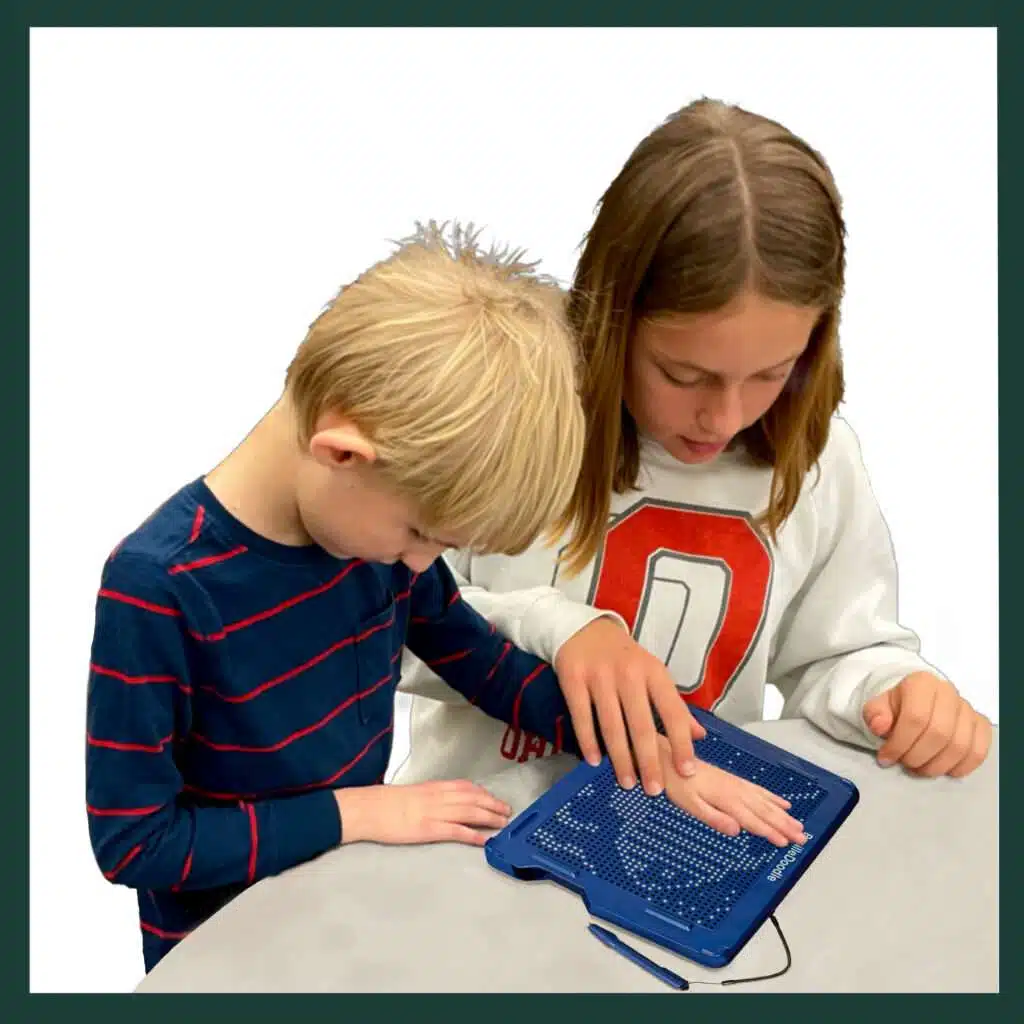
Teach blind and low-vision students to read and create a tactile bar graph with a practical 20-minute raised-dot activity, accessible labels, and simple data comparisons.

BrailleDoodle is a reusable, non-electronic tactile learning tablet designed to help learners practice Braille and create raised-dot drawings. It uses a magnetic stylus to bring metal balls

Before asking students to identify letters, explore touch through matching, texture discrimination, tracking, and finger movement. These are examples, not required prerequisites for every st

Math and science frequently rely on diagrams, charts, geometric figures, and graphs. Tactile instruction can give blind and low-vision learners access to spatial information through touch, s

Tactile drawing represents lines, shapes, and spatial relationships in a format that can be explored by touch. It can support artistic expression, communication, orientation, and concept dev
OUR FOUNDER’S STORY
For more than 20 years, my classroom was full of laughter and creativity. During my tenure as a Visual Arts Educator at NYISE (The New York Institute for Special Education), a school for blind and low-vision students, I watched brilliant children show extraordinary curiosity and intelligence. I was inspired like never before by every child and teenager’s enthusiasm for life, refusing to be defined by their vision impairment.
In early 2020, the pandemic hit. Overnight, the hands-on materials my students needed were unavailable. Most went home with nothing–to a screen they couldn’t see. The rate at which my students were learning didn’t just slow; in many areas, it stopped.
Day after day, I witnessed how, without access to assistive technological devices and equipment, their way of tactile learning was restricted. Many families faced barriers to accessing affordable Braille materials and tactile graphics. Drawing, shapes, math, and diagrams could be difficult to explore independently at home. I came to understand that access to tactile learning was a challenge far beyond my own classroom.
It became clear that the world needed a low-cost, durable device that could put tactile learning into the hands of every person who could benefit from it. Such a device would provide anyone with the opportunity to learn regardless of their location or economic situation.
I began sketching and tinkering. Night after night, I sat at my desk with magnets, toys from Amazon, metal beads, cardboard, duct tape, and my trusty X-Acto knife. I asked myself: How do we give a learner with a vision impairment something as fun as a toy, yet that will work as a powerful and intuitive learning tool that any blind or low-vision child or adult could use at home or at school?
Over months of trial and error, a simple but revolutionary idea began to emerge, a two-sided tactile tablet—one for drawing and exploration, one for learning and practicing Braille. No electricity or Wi-Fi required. From touch and imagination to a pathway to literacy, creativity, and independence.
In December 2021, I founded The TouchPad Pro Foundation Inc. (TPPF). It took years of research, fundraising, and engineering to bring us to where we are now. Over time, we became a diverse team of parents, educators, accessibility specialists, researchers, clinicians, and nonprofit leaders—many of whom are blind or have low vision. Without help from the TPPF team, the BrailleDoodle, as it is, would not exist. Together, we bring deep expertise and lived experience to expanding Braille literacy and tactile learning worldwide.
For interviews, product information, or the story behind BrailleDoodle, contact our founder and Executive Director.
Daniel Lubiner
Sign up for BrailleDoodle news, Foundation updates, and stories from our community.